
 Image 1 of 1
Why do the same patterns of institutional control, blood sacrifice, and suppression of direct spiritual experience appear across civilizations that supposedly developed independently?
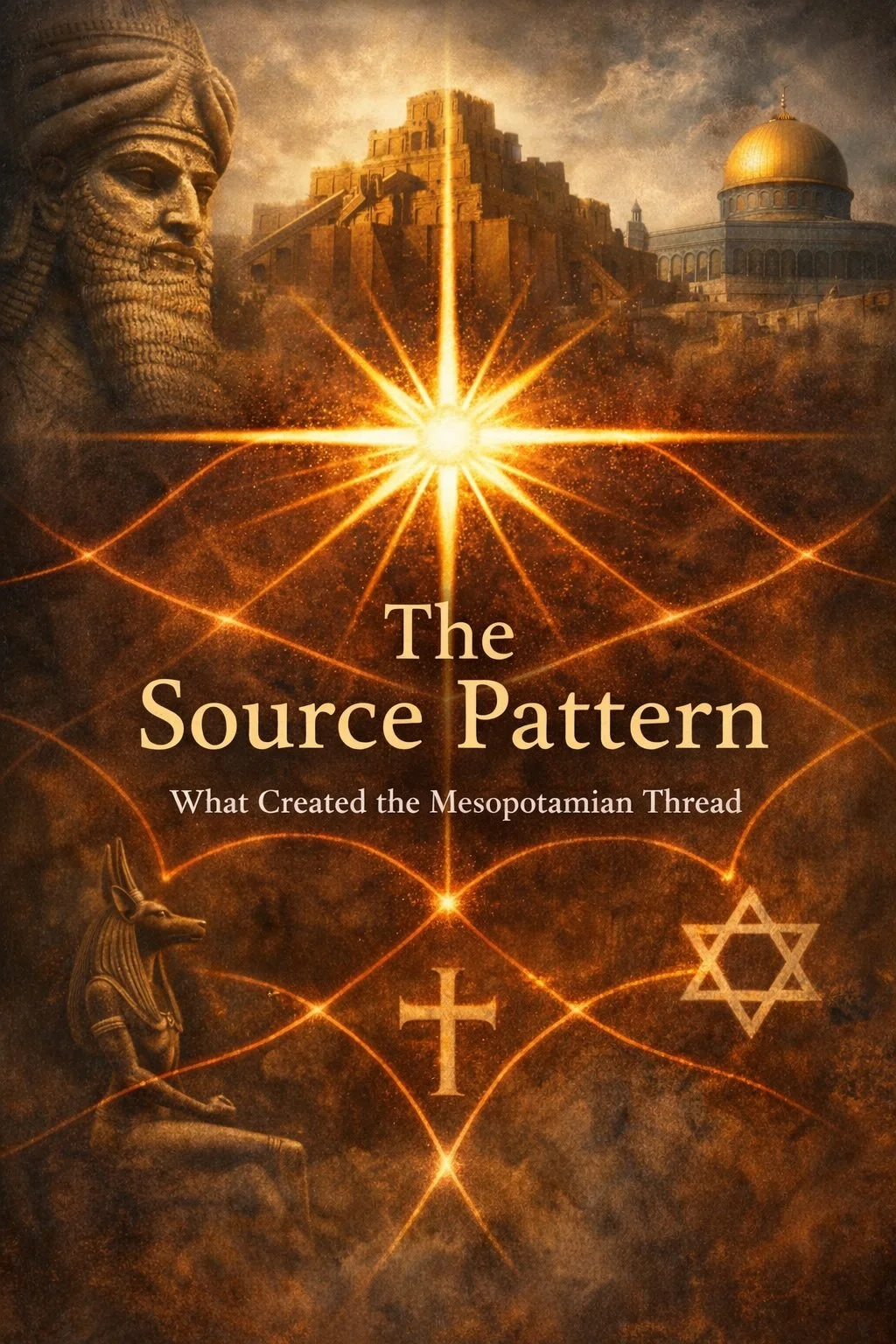
The Source Pattern traces a specific cluster of features across Mesopotamia, Egypt, the Indus Valley, Peru, and Mesoamerica: stepped pyramid construction, blood theology claiming gods require sacrifice for cosmic maintenance, astronomical knowledge pursued far beyond agricultural needs, and priest king hierarchies claiming divine mandate. The cluster appears with remarkable consistency despite geographic isolation. It doesn't appear universally. It appears in specific places, at specific times, with specific characteristics that resist explanation through coincidence alone.
The investigation begins 12,000 years ago at Göbekli Tepe, where sophisticated knowledge appears without precedent in the aftermath of a global catastrophe, and moves through the suspicious emergence of complex civilizations around 3500 BCE, through the Mesoamerican parallel that breaks conventional explanations, and into the present day, where declassified military research validates consciousness capabilities that institutional authorities have suppressed for millennia.
Four competing frameworks are evaluated with equal rigor. Each is tested against what it explains well and what it struggles with. The conclusion is probabilistic rather than certain, because intellectual honesty demands acknowledging what remains unknown.
But the book's most urgent contribution may not be its answer. It may be its questions.
We are living through simultaneous institutional collapse, and the standard explanations are not adequate. The Source Pattern asks whether the institutions themselves are structured around patterns old enough and consistent enough to suggest something beyond ordinary drift. That question is worth asking regardless of which framework ultimately explains it. At a moment when consciousness research is accelerating, when governments are acknowledging phenomena they spent decades denying, and when artificial intelligence is forcing fundamental questions about the nature of mind, this investigation connects documented military research most people don't know exists to questions about what human consciousness can actually do and what has been systematically prevented.
The patterns are real. The question of what created them deserves serious investigation rather than reflexive dismissal. This book provides that investigation.
Why do the same patterns of institutional control, blood sacrifice, and suppression of direct spiritual experience appear across civilizations that supposedly developed independently?
The Source Pattern traces a specific cluster of features across Mesopotamia, Egypt, the Indus Valley, Peru, and Mesoamerica: stepped pyramid construction, blood theology claiming gods require sacrifice for cosmic maintenance, astronomical knowledge pursued far beyond agricultural needs, and priest king hierarchies claiming divine mandate. The cluster appears with remarkable consistency despite geographic isolation. It doesn't appear universally. It appears in specific places, at specific times, with specific characteristics that resist explanation through coincidence alone.
The investigation begins 12,000 years ago at Göbekli Tepe, where sophisticated knowledge appears without precedent in the aftermath of a global catastrophe, and moves through the suspicious emergence of complex civilizations around 3500 BCE, through the Mesoamerican parallel that breaks conventional explanations, and into the present day, where declassified military research validates consciousness capabilities that institutional authorities have suppressed for millennia.
Four competing frameworks are evaluated with equal rigor. Each is tested against what it explains well and what it struggles with. The conclusion is probabilistic rather than certain, because intellectual honesty demands acknowledging what remains unknown.
But the book's most urgent contribution may not be its answer. It may be its questions.
We are living through simultaneous institutional collapse, and the standard explanations are not adequate. The Source Pattern asks whether the institutions themselves are structured around patterns old enough and consistent enough to suggest something beyond ordinary drift. That question is worth asking regardless of which framework ultimately explains it. At a moment when consciousness research is accelerating, when governments are acknowledging phenomena they spent decades denying, and when artificial intelligence is forcing fundamental questions about the nature of mind, this investigation connects documented military research most people don't know exists to questions about what human consciousness can actually do and what has been systematically prevented.
The patterns are real. The question of what created them deserves serious investigation rather than reflexive dismissal. This book provides that investigation.